
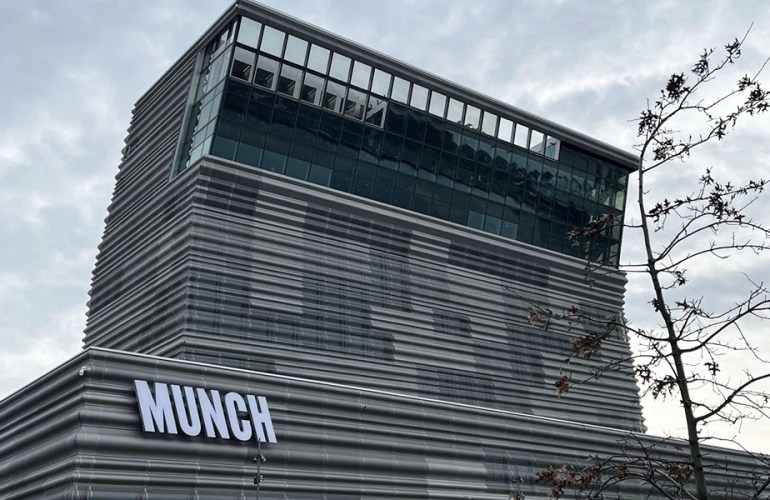
A short trip to Oslo saw us at one of the must-see galleries in Norway, and it was more than a scream!
There was a grey overcast that had settled in over Oslo, and a touch of frost in the air as we approached the brutalist-steel Munch Museum. Completed in 2021, this modern bit of architecture is already an iconic landmark, bringing in art-hungry tourists to see the life and works of Norwegian artist Edvard Munch.
Spanning several floors, the exhibition is divided into 12 themes: Alone, To Die, The Scream, Love, Gender, Outdoors, Naked, Others, Oneself, In Motion, On the Surface and Variations. The idea is to find ‘your’ Munch.

Walking into a museum wholly dedicated to Munch, I’ll be honest, I didn’t have any prior knowledge of his work, except of course his most famous painting, ‘The Scream’ – so I felt a little bit out of my depth. But it was actually a refreshing surprise to see these sultry, stylistic paintings, that felt very modern. I could have been walking into a contemporary painting show at the Tate.


There are layers and depths of narrative to unravel in his paintings. He explored human mortality, sometimes with brutal bluntness, others in a simple human connection or embrace. One painting that oozed emotion and hinted at mortality is ‘Love and Pain’ (above left). It has also been called Vampire, but it shows a woman embracing a man and kissing him on the neck. Her flowing red hair could suggest something more sinister and blood-lusty, but really it’s a man appearing vulnerable in an anguished state. It was considered shocking when it was unveiled, but to me, it feels like we’re witnessing a deeply emotional private moment.

Considered part of the Expressionist and Symbolist movement, Munch’s painting style can be highly abstract in subject matter and sometimes Freudian-esque with its psychological aspects. That’s what’s surprising about his work – you sense that they are ever-evolving and you can find new perspectives the deeper you go.
Birth, love, death – all the fundamentals of human existence are represented. There’s a deeply psychological emotional attachment to his paintings, none more apparent than one of Western art’s most iconic image, ‘The Scream’.
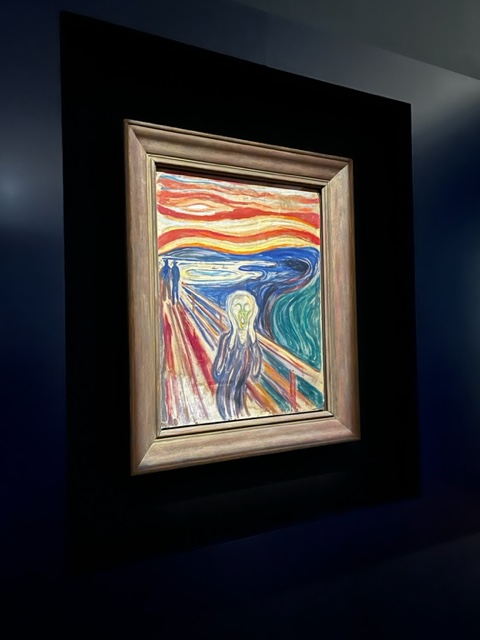
Enclosed in its own dark space, it’s something of a spectacle for tourists. And no wonder! It’s probably the only reason why you’ve heard of Munch. Part of a tetralogy, this work supposedly symbolises the anxiety of the human condition. The blood-red sky, the expressionist brushstrokes and the ghoulish character in the foreground lends itself to a very charged and moving image. I wasn’t overwhelmed by this piece, in fact, Munch has much better works in his repertoire (in my opinion). It might be that as an iconic image, the work has been over-saturated and publicised in the media, to the point of being diluted. Don’t go just for ‘The Scream’, there’s so much more to experience and digest!


With weighty themes to explore, across several floors, you can experience not only his giant paintings and murals; there is also a digital recreation of his home and contemporary works influenced by him. As an art enthusiast, you won’t be disappointed to have the Munch Museum on your tick list when visiting Oslo!
 artmyface